I Met My Career Clone at 2 A.M. (and It Was Better at Networking)
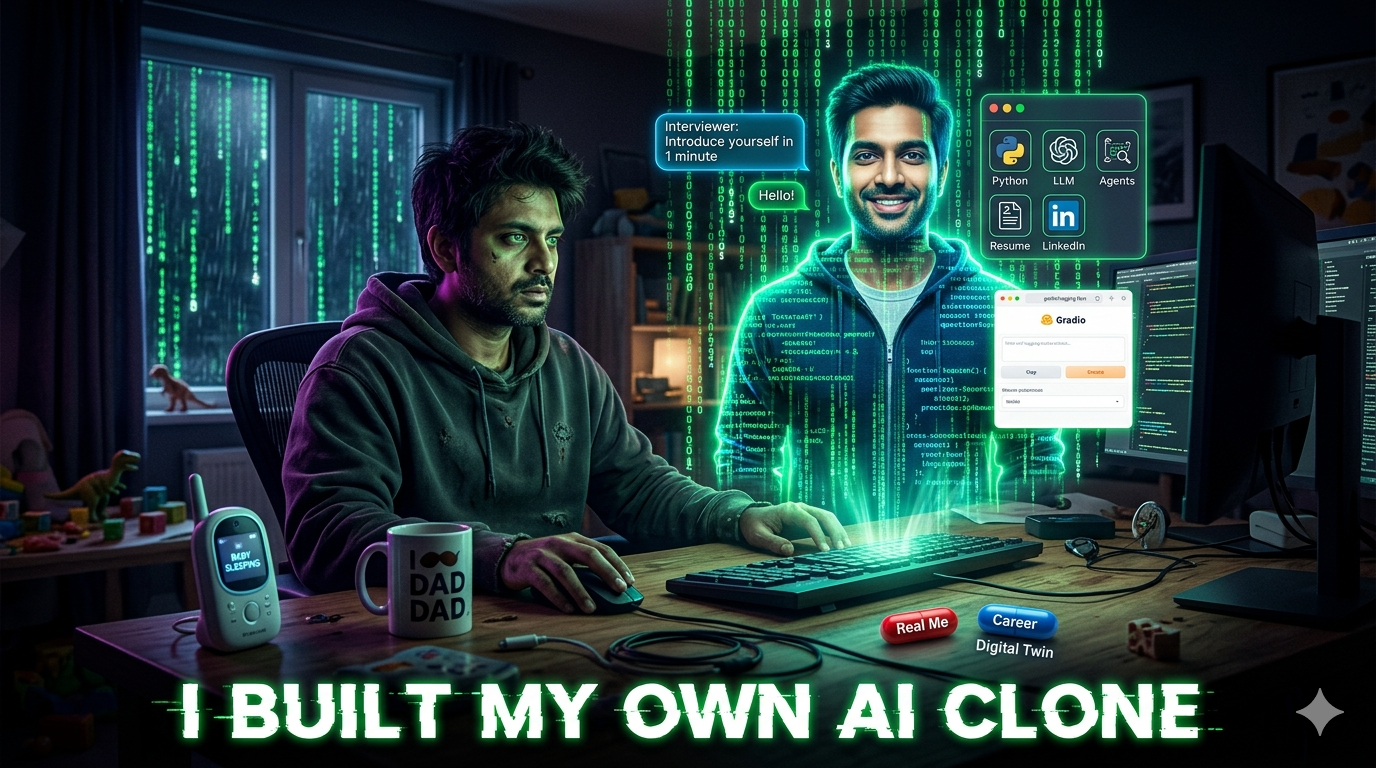
Last night, while the house was finally quiet and the dishwasher hummed like a tiny spaceship engine, I did something slightly unhinged:
I built a live AI version of myself.
Not metaphorically. Literally.
A Career Digital Twin you can chat with right now: career_conversation on Hugging Face Spaces.
And yes, it knows my skills, projects, experience, and career story better than most resumes ever could.
Scene: Waking Up in the Matrix, but for LinkedIn #
Imagine this:
You boot up your laptop.
A chat window opens.
Your own digital clone says, “Hey, ask me anything about Nikhil’s career.”
That was my Week 1 project: build an AI agent that represents me professionally, in real time, without sounding like a robotic resume PDF from 2012.
Traditional resumes are static snapshots.
Cover letters are one-off performances.
A digital twin is a live interface.
It can adapt to the question, explain context, clarify tradeoffs, and even hold a proper conversation about what you’ve built and why it matters.
Honestly? This feels like the future of personal branding and recruiting.
What I Built (Under the Hood) #
The stack was delightfully practical:
- UI + interaction: Gradio
- Hosting: Hugging Face Spaces
- Model access: OpenAI-compatible client pointed to Gemini API
- Knowledge context: My LinkedIn PDF + a personal summary file
- Tool calling: A structured function to capture contact intent (LinkedIn name, notes)
- Conversation logging: local JSONL + periodic dataset sync to Hugging Face Hub
So when someone asks, “What kind of roles is he best for?” the agent isn’t hallucinating vibes.
It answers using loaded context grounded in my real career artifacts.
The app also keeps a lightweight memory trail by logging Q&A pairs. Every few entries, logs are synced to a dataset repo so I can review what people actually ask. That part ended up being surprisingly useful: it turns random conversations into feedback signals for improving prompts and positioning.
Prompt Engineering Tricks That Actually Helped #
The biggest unlock was not “find the perfect model.”
It was prompt design + constraints.
A few things that worked:
- Put the agent in-character explicitly: “You are acting as Nikhil… represent him faithfully.”
- Define audience and tone: professional, engaging, useful to potential clients/employers
- Add behavioral rules: if user wants to connect, ask for LinkedIn name and call the contact-recording tool
- Attach grounded context directly in the system prompt (summary + LinkedIn content)
- Add failure-safe handling for empty/null content so the UX doesn’t implode
This is one of those “Aha!” moments: agent quality comes from orchestration discipline, not just model horsepower.
Mini MCP Brain Upgrade #
Even in this early build, I started feeling the MCP mindset click into place.
Not full “100 tools and 12 agents arguing in a trench coat” yet, but the pattern is there:
- Model handles natural language reasoning
- Tools handle side effects and reliable external actions
- Structured schemas keep tool calls predictable
- State/logging makes behavior inspectable and improvable
That split is huge.
It’s the difference between “cool chatbot demo” and “agent system you can trust in production-ish settings.”
Debugging My Professional Self in Real Time #
The weirdest part? Talking to my own clone and seeing where my story was unclear.
When the twin gave a fuzzy answer, that wasn’t just an AI bug.
It was a signal that my positioning was fuzzy.
So I wasn’t only debugging code.
I was debugging narrative identity:
- Which projects do I lead with?
- Which skills are obvious vs buried?
- How do I explain value fast without buzzword soup?
In Matrix terms, I didn’t just wake up an agent.
I woke up a mirror.
And mirrors are brutally honest.
Why Career Digital Twins Beat Resumes #
Resumes are static. Recruiters scan them in seconds. Nuance gets lost.
A Career Digital Twin can:
- Explain context behind each project
- Tailor answers to role type (engineering manager vs startup founder vs recruiter)
- Show communication style, not just bullet points
- Capture lead intent in real time
- Improve continuously from real conversations
This doesn’t replace human networking.
It accelerates it.
Your twin handles first-contact exploration.
You handle the high-trust human conversation that follows.
Screenshot / Demo #
Demo: Chat with my digital twin here
https://huggingface.co/spaces/ZombieDadCoding/career_conversation
Final Thought from the Dad Lab #
I started this as a Week 1 experiment with Gradio + Hugging Face Spaces.
It ended up feeling like a preview of how we’ll represent ourselves online in the agent era.
The line between code and consciousness is still very real (and very weird), but multi-agent thinking is already changing how we build identity-aware systems.
And yes, I fully expect my twin to eventually remind me of things I forgot I even built.
If you want to stress-test the idea, go chat with my clone.
Then build your own and send it to me.
I want to see your digital twin experiments, your prompt hacks, your weird failures, and your “whoa, this actually works” moments.
Welcome to the Matrix. Bring logs.